
WXTJ Writes! by Phoenix Banks: “Cotton candy, Majin Buu”: Understanding anime references in music
By Phoenix Banks
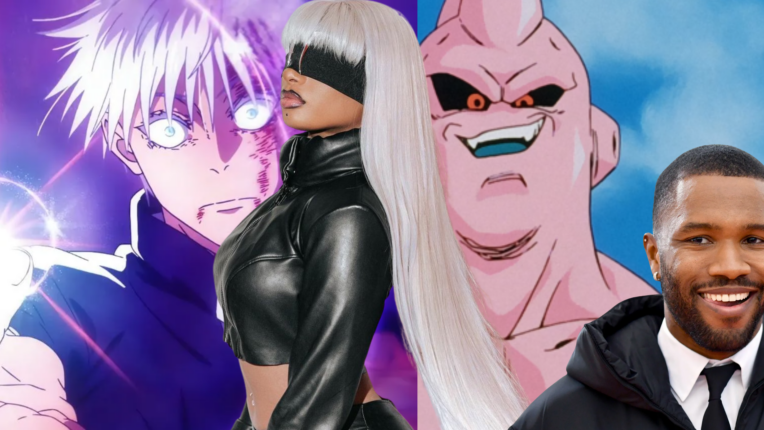
Between lyrics of casual intimacy between partners and homages to worshiping a lover, Frank Ocean sneaks in a reference to the pink gelatin villain of the final arc of Dragon Ball Z. He sings, “Cotton candy, Majin Buu,” a direct reference to Akira Toriyama’s hit 90s manga, which would later be adapted into an anime of the same name.
The first time I heard “Pink Matter” by Frank Ocean and Andre 3000 from Ocean’s 2012 album Channel Orange, I was surprised by the line “Cotton candy, Majin Buu.” I had just finished watching the anime Dragon Ball Z, specifically the Majin Buu arc that wraps up the series.
It was shocking to me that a musician like Ocean could also have watched Dragon Ball Z and enjoyed it so much that he included it in one of his songs. The song opened the floodgates to understanding the connection between music and anime—something much more common than originally imagined.
Ocean’s “Pink Matter” is not the first time that anime has been referenced in music, and it is far from being the last. The short answer is that a lot of your favorite musicians are a lot nerdier than you may think. A longer answer would be that anime and music often draw from each other, as any form of media can inspire and inspire the other.
Anime is incredibly popular with black musicians, and that may lie in a number of reasons. For one, many anime have a plot that black Americans can relate to. The main characters in these shows are often underdogs, facing conflicts or violence over things they can’t control. They then overcome these feats with confidence and perseverance that uplift them from unique systems of oppression. These plots speak directly to the Black American experience, where they have faced extreme oppression for characteristics that they are unable to control and are only able to overcome through strength and continuous struggles for freedom.
Even though anime has become a more inclusive space for black characters on screen, that doesn’t mean it’s always been that way. For a long time, black characters either did not appear in anime or, if they did, then they were presented as caricatures, as seen with Mr. Popo from Dragon Ball Z, whose physical appearance mimics blackface. In more recent years, though, anime has become a space where blackness is celebrated with better character design and more developed characters. Nonetheless, among all anime, Dragon Ball Z reigns supreme as one of the most popular among the black community, especially for its impact on hip-hop and rap culture.
Megan Thee Stallion, who has made herself known as an avid anime fan, makes several references to anime in a multitude of her songs. In her song Girls in the Hood, she makes a reference to the anime Naruto with the lyric, “P****y like a Wild Fox, lookin’ for a Sasuke.” The Wild Fox refers to the nine-tailed demon fox that becomes entrapped within the titular main character, Naruto Uzumaki. While Sasuke is a reference to Naruto’s friend and rival from the anime. The lyric refers to Naruto’s constant search for Sasuke Uchiha throughout the anime and its sequel.
Stallion also includes references in her song “Otaku Hot Girl,” which opens with an intro by Adam McArthur, the English voice actor for Yuji Itadori in the anime Jujutsu Kaisen. At the beginning, he says, “I like a tall woman, with a nice big a**. Just sayin’, like Grammy award winner Megan Thee Stallion.” A direct reference to how Yuji Itadori in the anime says his ideal woman is actress Jennifer Lawrence to his peer Aoi Todo.
Furthermore, in the song, she makes another reference to Jujutsu Kaisen when she says, “Ayy, can’t touch me like Gojo.” In this line, she discusses how no one can touch her because she’s so good by using an allusion to Gojo Satoru, one of the strongest characters in the show. Gojo uses a special ability called a cursed technique that causes none of his opponents to be able to touch him unless he allows them to do so. Hence, providing the perfect line for a rapper like Stallion to express how far above her opponents she is—she’s so good that they simply can’t touch her.
Childish Gambino includes a reference to Goku in his song ‘All the Shine’ off of his 2011 album Campfire. In the song, he includes a line that says, “Honesty, I’m rappin’ ‘bout everything I go through/Everything I’m sayin’, I’m super sayin’ like Goku.” Gambino uses a double entendre, or a figure of speech in which a writer includes a word or phrase that has a dual meaning. In this case, the line not only implies that everything Gambino says is true but also that it carries power. Super Saiyan is a power form achieved by characters like Goku in the anime Dragon Ball Z. Goku is part of a warrior alien race called Saiyans. Saiyans can achieve a different form by gaining more power and experiencing intense emotional moments, a form that Gambino discusses in the line.
Anime also appears in music videos, which allow artists to visually depict their music for audiences. One such example is Kanye West’s ‘Stronger’ music video, which takes direct references from the 1988 movie Akira. The movie, adapted from the manga of the same name, follows gang leader Shotoro Kaneda as he attempts to save his friend Tetsuo Shima after the latter develops telekinetic powers following a car crash with the government.
When the film came out, it was a major success in Japan. Though it did not achieve the same success in America as it did in Japan, it became a cult classic and saw renewed interest in later years. Its influence has been a pillar in animation, with one of its most iconic moments being Tetsuo Shima’s motorcycle glide. The glide has been replicated in cartoons and movies ever since, such as Batman: The Animated Series and Teen Titans. West even gives his homage to this move in the music video.
In the music video, West takes several scenes directly from the movie. He replicates the hospital scene where Tetsuo is experimented on by the government. This scene is pivotal in the animated movie, as it shows the tortured psyche that Tetsuo begins to develop, which emerges in the latter half of the movie.
Kanye also draws creative inspiration from the setting of Akira, a neo-Tokyo, after the original was destroyed by one of the government’s test subjects. This setting fills the music video with a vibrancy that only Japan can provide while also giving the audience a futuristic visual.
The song’s theme also speaks clearly to the conflicts within Akira. In the song, Kanye discusses that what doesn’t kill you only makes you stronger. Throughout the movie, Tetsuo struggles with the powers that he has been given, powers that should have killed him, but essentially give him gifts that are stronger than anything he has ever experienced before. By the time the end of the movie comes around, Tetsuo and the audience realize just how unstoppable Tetsuo is.
Anime was, is, and will be culturally relevant. Just as American audiences inspired the birth of manga, the print versions of many anime decades ago are doing the same for American musicians. Like most allusions, anime adds another layer to the meaning of song lyrics and serves as an easter egg for fans to enjoy while listening. While also empowering and inspiring musicians in ways that only fiction can.
Phoenix Banks (she/her) is a second-year student and DJ for WXTJ. She is the Editor-in-Chief for WXTJ Writes! and also hosts her radio show, “the rhythm archive” on Thursdays from 3 pm-4 pm.