
WXTJ Writes! By Phoenix Banks: Hollywood’s Newest Obsession—An Analysis of Music Biopics
By Phoenix Banks
Movie theaters, now more than ever, are filled with superhero flicks and heartbreaking dramas, and biopics stand out as a unique genre that blends biography and film. They present an opportunity to explore the lives of some of the most influential people of our time. Biopics’ special ability to tell the story of a celebrity, historical figure, or other notable person often stands out to audiences who want a true story with the elements of fictional storytelling.
In the past couple of years, moviegoers and music fans alike have seen biopics about artists ranging from Bob Dylan and Elvis Presley to Amy Winehouse and Whitney Houston. With the new Michael Jackson film out, it’s the perfect time to take a deeper look at music biopics and why Hollywood seems so obsessed with making more of them.
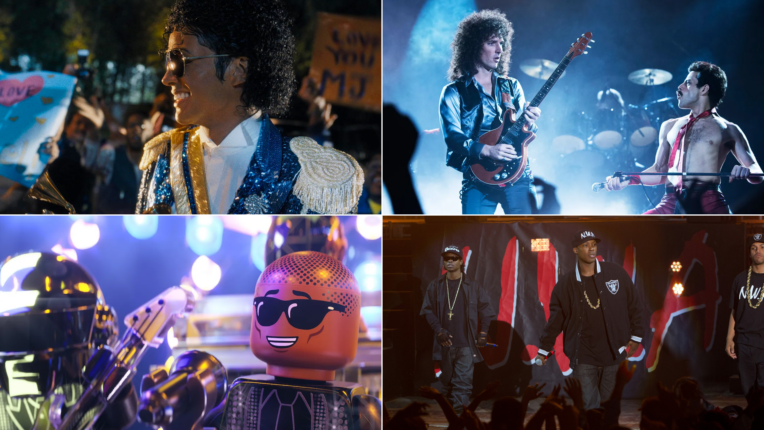
Biopics have always been a constant in theaters around the world, but it wasn’t until the 2015 film Straight Outta Compton that music biopics became more mainstream. The film depicts the rise and fall of the 90s hip-hop group N.W.A. with a cast that includes Ice Cube’s own son, O’Shea Jackson Jr. The movie was a box-office success and became the highest-grossing music biopic at the time, earning positive reviews from both critics and audiences. The movie’s success made it clear to directors that audiences were open to watching movies about music from the past, effectively opening the floodgates for more music biopics.
Respectively, biopics have also earned acclaim for many actors. Standout performances include Jamie Foxx as Ray Charles in Ray (2004), Rami Malek as Freddie Mercury in Bohemian Rhapsody (2018), and Timothée Chalamet as Bob Dylan in A Complete Unknown (2023). All of whom were nominated for Best Actor in a Leading Role at the Academy Awards, with Foxx and Malek even winning an Oscar for their respective portrayals.
Nonetheless, biopics take up a very difficult task: presenting someone’s life as accurately and effectively as possible. Not only do biopics have to convey the stardom that came with these musicians’ respective discographies, but they also have to capture the quiet moments and those from their personal lives, whether controversial or not.
For a musician like Michael Jackson, this is a bigger feat than most. Michael Jackson is one of the most successful musicians of all time, creating some of the biggest hits of the 80s and 90s. At one point, he was one of the most famous musicians in the world for both the best and the worst reasons. Jackson, alongside a multitude of awards for his music, was also accused of having inappropriate relations with children at his home, Neverland Ranch.
While Jackson was brought to court and later acquitted of these charges in 2005, they shaped the latter part of his life until his death, and remain in the center of discussions about Jackson’s legacy. Michael (2026) represents the problem many biopics face: conveying the essence of such a powerful cultural figure while also revealing the truth behind their public facade.
For past Michael Jackson biopics, this topic has either been too controversial to include or difficult to accommodate for audiences. Instead, these films opt to glamorize his stardom, leaving the rest of Jackson’s story to feel unfinished. This is where many biopics struggle walking the thin line between analyzing a figure and idolizing them.
Biopics often grapple with balancing the best and worst attributes of musicians. The issue of idolization versus analysis becomes clear when these movies omit some of their protagonists’ uglier sides. It’s difficult for some diehard music fans to accept that their favorite artists may not be perfect, but at the same time, moviegoers enjoy complex characters. Furthermore, some biopics are made with the support of the musician’s estate, which takes on the role of ensuring the musician is presented well. This results in the darker parts of their lives not being presented, for fear of damaging the musicians’ reputations with audiences.
Your favorite musician is still a human being, which means they make mistakes, they are messy, and they do things wrong time and time again. They deal with loneliness. They struggle with addiction. They have massive successes and horrible failures. All of these things should be present in movies about them because they make these films complete pictures of them and allow audiences to better understand them as individuals separate from their music.
Michel’le and a multitude of other women criticized Straight Outta Compton for omitting Dr. Dre’s domestic violence against them. Alongside the film’s omission of Dre’s domestic violence against women, the movie also omits the role of black women in the hip-hop genre. The film effectively only casts women as groupies, or female fans who follow bands, often in romantic or sexual roles. This is where biopics cross into the dangerous territory of idolizing the people they are portraying instead of showing them as the complicated human beings that they actually are.
There are some things music biopics do incredibly well. One of which being while they’re all about the musician, they use cinematic techniques to create unbelievable experiences for the viewer. Biopics often make concerts and musical moments feel real. When you watch the musicians perform, it feels as if you’re in the crowds surrounding Queen at their 1985 set for Live Aid or the girls fainting when watching Elvis perform. Arguably, some of the most memorable moments in biopics are when it feels as if the actor fully transforms into the musician, becoming indistinguishable from them.
Biopics also have the chance to bring a musician’s discography back into the mainstream. For some musicians, they died before the birth of a new generation, so making a music biopic about them allows audiences to reacquaint themselves with their music and makes their songs popular again. This is the case with music from the past, where movies can evoke a sense of nostalgia in audiences. A good example of this would be Walk the Line (2005), a movie about country singer Johnny Cash. The movie included some of Cash’s popular songs, such as “I Walk the Line” and “Ring of Fire,” to help audiences discover Cash’s music. Films such as these have the chance to reintroduce older music to a new generation of listeners.
Oftentimes, music biopics struggle to balance the expected cradle-to-grave narrative with an exploration of a single moment or section of the individual’s life. There are positives and negatives for each of these formats. As a cradle-to-grave concept, it aims to encompass a musician’s entire life or career, but often has to leave out details or points because the movie needs an acceptable runtime. On the other hand, when a director focuses on a single moment or section of a musician’s life, they can deliver a compelling portrayal, but it may leave the rest of the story feeling incomplete.
It should not be surprising that the music biopics that stand out are those that take creative initiative and are committed to presenting the musician’s image. A great example of this is Piece by Piece (2024), which tells the story of local Virginia artist Pharrell Williams. With a star-studded cast and fiery music, the biggest standout was the creativity in the movie’s filming. Piece by Piece was unique because it was filmed using LEGO sets rather than live actors. The film’s use of LEGO sets was also helpful in conveying Williams’ story of synesthesia, a condition in which certain stimuli can trigger responses in different senses. In this case, Williams imagines shapes and colors when listening to music. He wanted his biopic to stand out, and amongst traditional standards, it certainly did.
There’s no doubt that music biopics are among Hollywood’s newest obsessions, and for good reason. They bridge the gap between music lovers and moviegoers by providing an enjoyable experience that combines music and storytelling. These films allow fans to enjoy glimpses of these musicians’ lives that they themselves were often unable to see. Music biopics keep music alive in forms that may not have seemed possible before. Whether through the compelling storyline or the hit songs, movie and music fans will continue to find common ground in music biopics time and time again.
Phoenix Banks (she/her) is a second-year student and DJ for WXTJ. She is the Editor-in-Chief for WXTJ Writes! and also hosts her radio show, “the rhythm archive” on Thursdays from 3 pm-4 pm.

