
WXTJ Writes! By Phoenix Banks: When the Music Speaks: Soundtracks as the Soul of Cinema
By Dylan Jiron
Before I understood cinematography, lighting, or scene cuts, I understood what music did for a movie. Like most children of the late 2000s, I grew up on some of the best movie soundtracks, from Disney to DreamWorks. I understood what it meant when a song came on and completely shifted the movie’s meaning and atmosphere. Before I knew what it meant for a film to have good writing, I understood the plot by listening to the music that the characters sang or the pieces that played in the background when they arrived.
This sentiment could not be more accurate in black cinema, where everything from the artists featured on a soundtrack to the very soundtrack itself is intentional. Every lyric, note, and voice works as a guide through the movie. One there to whisper when to shout, when to clap, when to cry, and when to brace yourself. This is where black film separates from the mainstream, while others simply use movie tracks as simple movers of the narrative. Black movies use songs and pieces as a language of their own.
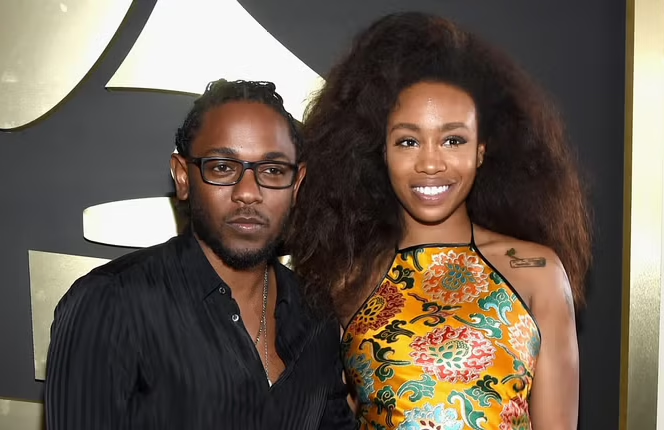
There was no greater experience than sitting in the theater, listening to ‘All the Stars’ by Kendrick Lamar featuring SZA play over the end credits of Black Panther (2018). One of the most profound songs on the entire soundtrack, a perfect collaboration between two of the most prominent figures in black music, thoroughly explores the themes of Afrofuturism, love, and connection in Ryan Coogler’s Black Panther. Alongside Kendrick Lamar and SZA, the Black Panther soundtrack features The Weeknd, Travis Scott, Khalid, and Swae Lee.
With each powerful song on the playlist, one thing becomes imperative for the movie’s viewers: this is a film made for black people. A film that emphasizes black power and excellence, separate from white standards, needs a soundtrack that promotes these ideals. A soundtrack that collides soul with trap, rap with R&B, and poetic hip-hop with pure African beats.
One of my personal favorite movies, Waiting to Exhale, also uses soundtracks as its own expressive language. The soundtrack features songs by all-black female artists, including some of the biggest names of their time, like Toni Braxton, Faith Evans, and Mary J. Blige, while also featuring a song performed by one of the main characters, Whitney Houston. Each song on the soundtrack didn’t just underscore the movie but also communicated with the audience in the same intimate way the film’s dialogue does. Each song seems to have its own conversation about love, heartbreak, and the value of female companionship.
In ways that other popular movie soundtracks lack, Waiting to Exhale’s soundtrack features R&B songs that highlight the romantic tensions, vulnerability, and perseverance of the movie’s four leading ladies. Like other influential black films, Waiting to Exhale uses music and artist choice intentionally. There’s a reason why no men feature on the soundtrack and why men barely take the foreground of the film. Even when the characters or songs seem to revolve around a man, they actually delve into an even deeper understanding of women and relationships in the 20th century.
The Into the Spider-Verse and Across the Spider-Verse movie soundtracks sound like finding yourself and becoming confident in the person that you are. In the first Miles Morales movie, Into the Spider-Verse (2018), the soundtrack features young artists to highlight the initial excitement and nervousness of becoming a young superhero. The soundtrack’s standout, ‘Sunflower’ by Post Malone and Swae Lee, plays a jovial tune for Miles to enjoy in the movie, but also encourages him as he attempts to hold onto his own family and universe as he begins this new journey.
The soundtrack, however, for Across the Spider-Verse (2023) shows a more established Miles Morales, unlike the amateur superhero audiences saw in the first movie. The soundtrack also includes more established and well-known artists like Future, Nas, and 21 Savage. The music also blends the numerous other personalities that appear in the second movie, creating a soundtrack that is just as expansive and diverse as the movie itself. The soundtrack was produced by Metro Boomin, who uses each track to evoke something as emotionally charged as Miles Morales. That moves and electrifies with every scene. In Across the Spider-Verse, the music doesn’t just follow Miles but instead challenges him and provokes him as well.
I am saying all of this to say that there is something revolutionary about seeing a movie screen full of people who look like you, who are proud and happy to look like you, who are living their lives, being superheroes, saving the world, and the music that plays throughout the film is written by your own people too. Something was life-changing about the first time I watched Black Panther (2018) in theaters, hearing Kendrick Lamar and SZA while the end credits rolled for one of the best movies of the decade. An experience I’m sure was replicated across many age groups over time, most recently with The Little Mermaid (2023). An experience that is truly poetic about seeing the representation you have always
wanted for so long.
One of my favorite things to do after seeing a movie I really love is checking out the soundtrack on streaming. There is nothing better than the drive home from the movies, listening to my favorite songs from the tracklist, rethinking all the scenes that went with them in my head, and then wondering about the deeper story behind each lyric. No movie would truly be complete without killer music to accompany every scene, highlighting every crescendo and understanding the most pivotal moments for each character. Black cinema relies heavily on soundtracks, the music of its people, to communicate directly with the audience in ways that other movies can’t.
by Phoenix Banks